Background And Introduction:
Thailand's hospitality sector is defined by its small and boutique hotels, many of which are family-run businesses or limited partnerships.
A considerable number of properties in this segment demonstrate only a superficial understanding of core commercial disciplines, including market segmentation, pricing dynamics, and channel distribution. Few adopt a structured, data-driven approach to pricing, resulting in reactive rather than strategic rate management.
Without clear oversight and disciplined execution in these areas, small hotels often fail to maximize the revenue potential of their operations and location.

Hotel Candidate :
The Riski Hotel & Residence @Bangphlat Station had solid fundamentals: a great location near Bangphlat Station, quality rooms, and a dedicated team. What it lacked was structured price discipline, designed to capture its full revenue potential. In 2024, the property partnered with Hoteliers.Guru through the HotelGru revenue management service.
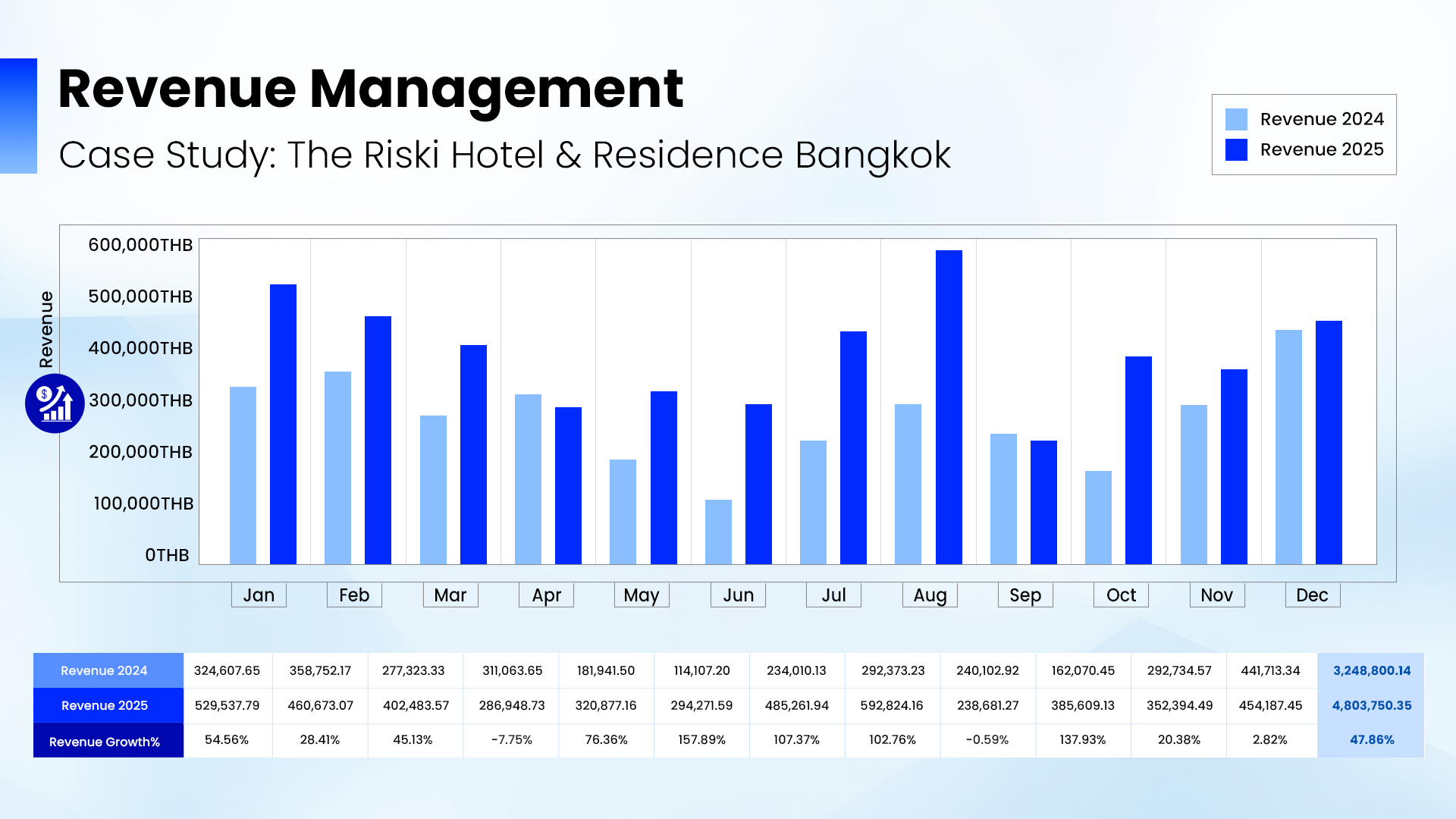
2025 Results: Total Revenue Increased by 47.86%
Within just one year of collaborating with Hoteliers.Guru and implementing the HotelGru service, the hotel saw its revenue soar by 47.86%. This growth was driven by the optimization of three key areas:
Aligning Cost with Market Demand
Effective revenue management requires balancing internal cost structures with external market conditions. Our team developed a pricing framework built on these core principles as follows:
Identifying and balancing both internal and external environment variables allowed us to set the foundation of our strategy.
Strategy Execution - 7 Unified Pillars
Technology Enablers
The transformation of The Riski Hotel & Residence @ Bangphlat Station was powered by three core technologies:
Integrating these systems simplified operations, eliminated redundant costs, and ensured total alignment between commercial strategy and daily execution.
The Winning Formula
The hotel achieved a 47.86% revenue increase through an integrated suite of strategies that created a multiplier effect. The success of The Riski Hotel & Residence @ Bangphlat Station is built on three fundamental principles:
Conclusion
This revenue growth was made possible by transitioning from an "ad hoc" sales approach to a structured, data-driven revenue management model focused on "Total Guest Value." This strategy aligns pricing with actual demand, strengthens market positioning through an improved reputation, and optimizes distribution to lower the cost of sales.
By establishing a disciplined pricing range between the cost floor and the market ceiling, the hotel successfully commanded higher rates during peak periods while maintaining occupancy during the low season. Simultaneously, elevating the hotel's online reputation drove higher conversion and supported sustainable Average Daily Rate (ADR) growth without relying solely on discounts.
Ultimately, the focus shifted to the total revenue generated per guest through ancillary products and upselling, unlocking significant incremental income and resulting in a quantum leap in overall profitability.